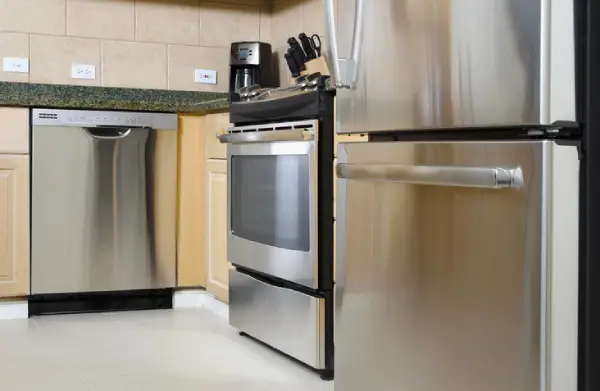
Mr. ApplianceⓇ explains why choosing professional help is a better option than DIY for kitchen repairs.
|
The modern kitchen houses a suite of advanced appliances. We have moved past the era of purely mechanical devices, where a wrench and a little grease could fix just about anything. Today, our kitchens are high-tech command centers.
When a refrigerator stops cooling, or an oven refuses to heat, the instinct to search for a tutorial video and grab a screwdriver is strong. But there’s a tipping point, where kitchen repairs shift from a weekend project to a potential hazard. While we champion the capable homeowner, we also believe in the value of knowing when a project is out of scope.
In this article, we’ll explore when and why you’d be better served seeking professional help than attempting to DIY a kitchen appliance repair.
Article contents
- FAQs About DIY Kitchen Repairs
The Evolution of the Kitchen: It’s Not Just Gears Anymore
To understand why DIY is becoming increasingly complex, we have to look at how appliances are built today. Twenty years ago, a washing machine was a motor, a belt, and a timer. Today, your dishwasher, refrigerator, and oven are essentially computers wrapped in steel.
Modern appliances rely on complex printed circuit boards (PCBs), digital sensors, and intricate wiring harnesses. When your refrigerator acts up, the cause may be a communication error between the user interface and the control board, or a sensor sending a false positive to the main computer—far more complicated than replacing a broken part.
The diagnostic trap
The biggest hurdle for the DIY enthusiast typically isn't the physical act of unscrewing a panel, but diagnosing the problem correctly. In kitchen appliance repairs, misdiagnosis is one of the top causes of wasted money.
Since parts usually can’t be returned once installed, incorrect replacements can leave homeowners out the cost of the part and the time spent installing it, while still dealing with a nonfunctioning appliance.
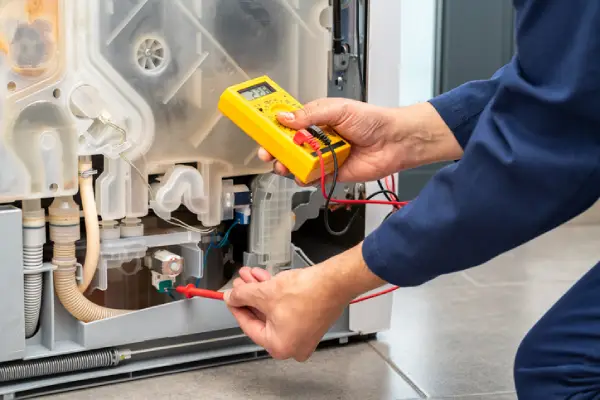
Service professionals carry specialized diagnostic computers and multimeters—and more importantly, the training to interpret what those tools are saying—to ensure the right part is fixed efficiently.
The Safety Factor: The Risks You Can't See
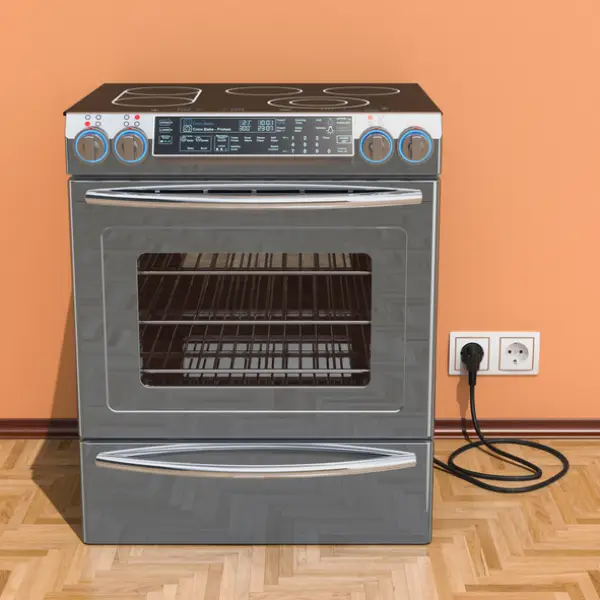
We often joke about “shocking” experiences in DIY, but the reality is that kitchen repairs involving major appliances can be genuinely dangerous. The kitchen is a unique environment where high-voltage electricity, water, and even natural gas all exist within inches of each other.
Electricity: High voltage hazards
Most small electronics run on low voltage. However, major appliances, like electric ranges, run on 240V. This is not just enough to give you a jolt; it is enough to cause severe injury or worse.
Even when unplugged, certain appliances, like the microwave, contain capacitors that store electricity and can deliver a dangerous shock to a hand that comes into contact with a wire.
Gas: The silent danger
If you have a gas range or oven, the stakes are even higher. A DIY error with a gas line isn't just an inconvenience; it’s a catastrophic risk. A slightly loose fitting or a seal that isn't seated perfectly can lead to slow leaks, which can cause carbon monoxide buildup or fire hazards.
Appliance repair professionals are certified to handle gas lines to ensure safety throughout the repair.
Water: The destroyer of flooring
Dishwashers and refrigerators with ice makers involve water lines. A DIY fix on a dishwasher might seem fine initially, but a slow drip behind the cabinetry can go unnoticed for weeks.
By the time you see the puddle, the water may have seeped into the subfloor, warped your hardwood, or encouraged mold growth behind the drywall. Suddenly, a simple part replacement has turned into an expensive flooring renovation.
Why the "Big Three" Are Best Left to Experts
Let’s look at the three most common kitchen appliance repairs and some potential complications with a DIY approach.
1. Refrigerator
When a modern fridge stops cooling, DIYers may assume it just needs a “recharge” of the refrigerant (often referred to as Freon).
Here is the reality: The refrigeration cycle occurs in a “sealed system.” If your fridge is low on refrigerant, the system has a leak, and simply adding more won't fix it. Furthermore, handling refrigerants requires EPA certification. You cannot legally or safely vent these chemicals into your home.
A qualified refrigerator repair professional knows how to recover the refrigerant, find the leak, braze the line, and recharge the system to the exact manufacturer specifications.
2. Dishwasher
Dishwashers are notorious for being difficult to diagnose, but they are also difficult to access. Reaching the critical components often requires pulling the unit out from under the counter, risking damage to your floor.
Modern dishwashers use turbidity sensors (to detect how dirty the water is) and flood sensors. If a DIY repair bypasses or damages a flood sensor, the machine won't know when to stop filling. Coming home to a flooded kitchen is a nightmare that no amount of DIY pride can soothe. Expert dishwasher repair is often the safer option.
3. Oven range
Baking is a science that requires precise temperatures. If your oven is off by 25 degrees, your food won't cook safely or correctly, and you’ll likely waste time and money running the oven longer to achieve the right result.
Replacing a thermostat or igniter seems simple, but calibrating the new part to the control board often requires a service mode that isn't accessible without a code reader and a service professional’s oven repair expertise.
The Hidden Costs of DIY Kitchen Appliance Repairs
The cost of DIY fixes often seems less than scheduling professional kitchen appliance repairs, but this is “false math.” In reality, expert service covers many costs that go beyond the price of replacement parts.
The true cost of DIY includes:
- Tools: Do you have a multimeter? A clamp meter? A specialized nut driver set? Tamper-proof Torx bits? Buying the tools to do the job once often costs as much as the service call.
- “Tuition” broken parts: These are parts that accidentally break while you’re trying to fix the original problem, such as plastic clips that hold the control panel fascia in place. Think of it as tuition for a lesson in what not to do!
- Time: How much is your Saturday worth? Several hours spent researching, driving to get parts, and wrestling with the machine add up to a massive amount of personal capital.
- Food spoilage: The longer you spend trying to fix a fridge or freezer, the more likely you are to lose money on spoiled food. A pro can often get you up and running the same day.
DIY kitchen repairs may void a manufacturer’s warranty
This is a crucial hidden cost that many homeowners overlook. If your appliance is 1–10 years old, it is likely still covered by a manufacturer's warranty—at least partially.
However, kitchen appliance warranties often specify that unauthorized repairs void the coverage. The moment you unscrew the back panel of your smart fridge, you may have just voided a warranty that was worth thousands of dollars.
On the other hand, if a qualified service professional performs the repair, the manufacturer generally respects that service. Risking a five-year warranty to save on a service call fee is a gamble that rarely pays off.
Make the Smart Choice for Kitchen Repairs

There is no shame in calling for backup. In fact, knowing when a task requires a specialist is the mark of a savvy homeowner. If you have modern kitchen appliances with electronic controls, water or gas connections, or smart functionality, repairs will require a level of specialization that most DIYers can’t match.
Mr. Appliance offers professional, qualified repairs for all kitchen appliances. We offer upfront quotes for all repairs and stand by our parts and labor with the Neighborly Done Right PromiseⓇ to ensure your satisfaction, every time.
If you’re debating whether to pick up the toolbox or the phone for your fridge, oven, dishwasher, or microwave, choose the path that delivers results the first time. Call your local Mr. Appliance team to schedule service for kitchen appliance repairs today.
This article is intended for general informational purposes only and may not be applicable to every situation. You are responsible for determining the proper course of action for your home and property. Mr. Appliance is not responsible for any damages that occur as a result of this blog content or your actions. For the most accurate guidance, contact the Mr. Appliance location nearest you for a comprehensive, on-site assessment.
FAQs About DIY Kitchen Repairs
Decades of experience, highly skilled service professionals, and a commitment to exceptional customer service have made Mr. Appliance a trusted leader in appliance maintenance and repairs. Our commitment to keeping your appliances up and running includes using our many years of experience and expertise to answer your questions. Here are answers to some of the most frequently asked questions about kitchen appliance repairs.